 Whatsapp
 Phone
Phone
 Mail
Mail

Jebel Ali Property Investment 2026 Guide
Published: Aug 6, 2026 · Last updated: Sep 16, 2026 · Share
On this page
- Jebel Ali Investment Snapshot
- Why Jebel Ali Is Becoming a Major Dubai Growth Corridor
- Jebel Ali Port and JAFZA: Demand That Already Exists
- Why employment-led demand matters
- Al Maktoum International Airport: The Long-Term Catalyst
- Dubai Metro: Converting Distance into a Practical Commute
- The Property Buyer’s Map: Where the Opportunity Actually Sits
- How SAMANA Projects Fit the Southwest Dubai Growth Story
- Frequently Asked Questions
- You may also like:
Interested in buying a property from SAMANA?
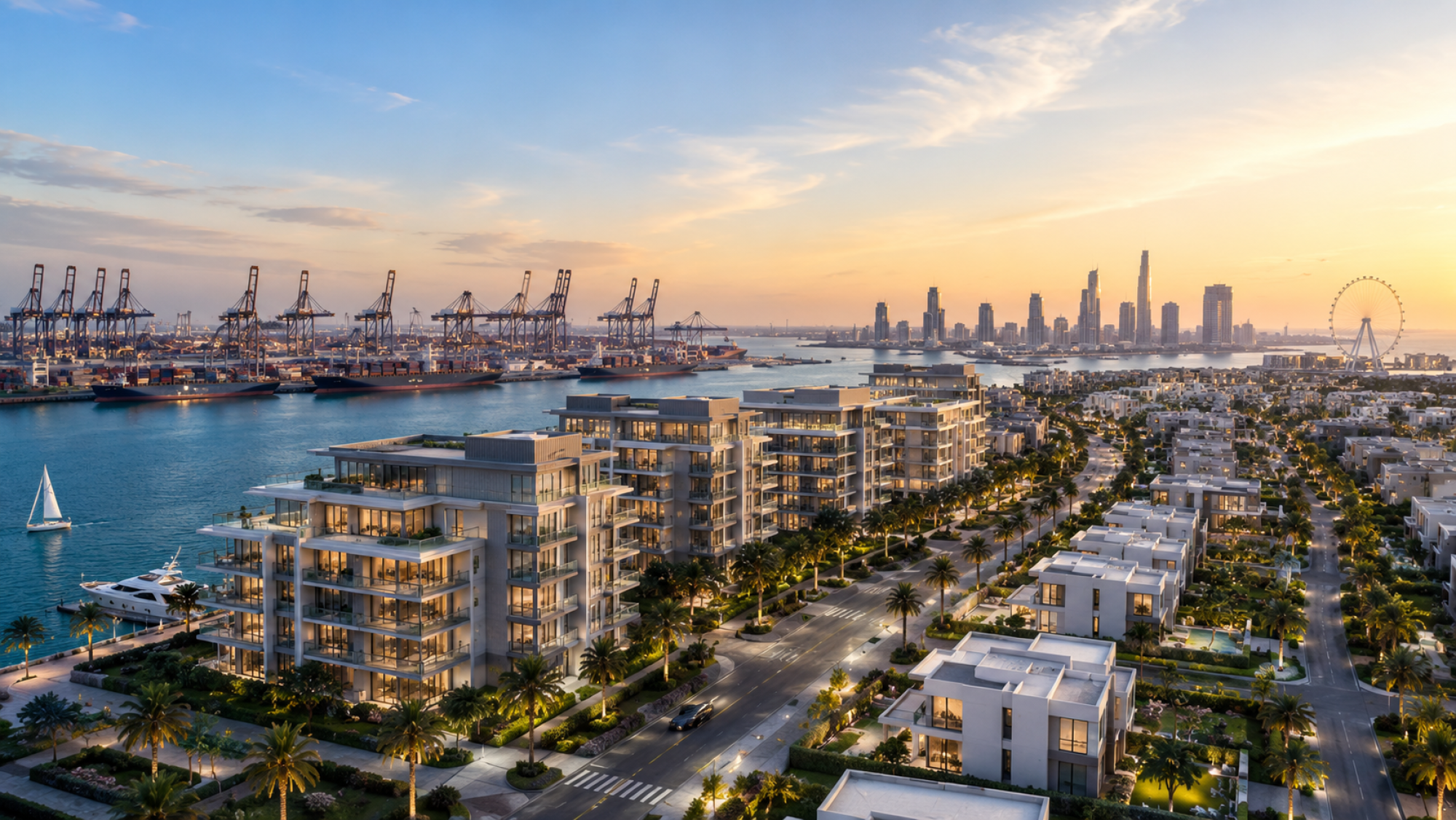
Jebel Ali property investment in 2026 is gaining attention as Dubai’s port, airport and metro-led growth corridors come together. The area combines Jebel Ali Port, JAFZA, Red Line connectivity, Expo City Dubai, Dubai South and the expanding Al Maktoum International Airport—major anchors that can support long-term residential and commercial demand. The launch of SAMANA Portside in Downtown Jebel Ali adds a new residential opportunity for buyers seeking modern apartments near employment and transport hubs. This guide explains the area’s investment potential, infrastructure catalysts, risks and buyer fit. For a wider location overview, read SAMANA’s Jebel Ali area guide.
Jebel Ali Investment Snapshot
|
Demand driver |
What buyers should know |
|
Jebel Ali Port |
Handled 15.5 million TEUs in 2024, its highest container volume since 2015, according to DP World. |
|
JAFZA employment base |
More than 11,000 registered companies and over 160,000 people working in JAFZA businesses, according to JAFZA. |
|
Al Maktoum Airport |
AED 128 billion terminal program; ultimate capacity above 260 million passengers and 12 million tons of cargo. |
|
Metro access |
The Red Line and Route 2020 serve Jebel Ali, The Gardens, Discovery Gardens, Al Furjan, Dubai Investment Park and Expo City. |
|
Indicative apartment yield |
Mid-2026 portals like Property Finder and Bayut, estimates generally place Jebel Ali apartment gross yields in the high-7% to high-8% range; actual net returns vary by building and cost base. |
Why Jebel Ali Is Becoming a Major Dubai Growth Corridor
Dubai’s property map often expands around
infrastructure and employment. Jebel Ali already has both. The port and free
zone create current economic activity, while airport expansion and new
residential development add a longer-term growth layer. This combination is
more important than any single headline because it can support several tenant
groups: logistics and manufacturing staff, aviation professionals, business
owners, families and residents who value Metro access.
The corridor should still be analyzed as a
group of connected micro-markets rather than one neighborhood. Downtown Jebel
Ali is a Metro-led apartment market. Jebel Ali Village offers a more
residential, family-oriented profile. The Gardens, Discovery Gardens and Al
Furjan are more established. Dubai South is a separate master development whose
investment case is more closely tied to the airport, Expo City and future
population growth.
Jebel Ali Port and JAFZA: Demand That Already Exists
Jebel Ali Port is not a future infrastructure promise. It is an established
global trade and logistics hub and one of the world’s largest man-made
harbours. The port handles more than 15
million containers annually and has extensive capacity across multiple
terminals, over 100 berths and approximately 25 kilometers of quay.
Next to the port, Jebel Ali Free Zone (JAFZA) strengthens the area’s property investment case. The free zone is home to more than 10,000 companies and supports a workforce of over 160,000 people across logistics, manufacturing, international trade, technology and professional services.
Not every employee
will choose to live near Jebel Ali, but this large and diverse employment base
creates genuine, year-round housing demand. For property investors, that is a
stronger foundation than relying only on future development announcements or short-term
market interest.
Why employment-led demand matters
- It is active throughout the year rather than dependent only on tourism seasons.
- It supports demand across several price points, from studios and one-bedroom apartments to larger family homes.
- It gives investors a clear tenant story: reduce commuting time for people working in JAFZA, the port, Dubai Industrial City and nearby business districts.
Al Maktoum International Airport: The Long-Term Catalyst
The largest future catalyst is Al Maktoum International Airport, also known as Dubai World Central. Dubai approved a new passenger terminal program valued at AED 128 billion. The airport is planned to handle more than 260 million passengers and 12 million tones of cargo annually at ultimate capacity, with five runways and 400 aircraft gates.
The program moved into large-scale construction in 2026. Dubai’s Media Office reported in June 2026 that the first phase remained on schedule to commence operations in 2032, with more than AED 13 billion of packages under execution and preparations for major additional awards. This is more useful to buyers than a distant master-plan promise because it confirms an active delivery program, although the full airport will develop over many years.
For real estate, the airport can expand the pool of aviation, logistics, hospitality, retail and support-sector workers who prefer to live in southwest Dubai. It may also accelerate schools, retail, roads and community facilities. Airport-led growth can support housing demand, but it does not automatically make every nearby project a good investment. Entry price, supply at handover and the quality of the immediate community remain decisive.
Dubai Metro: Converting Distance into a Practical Commute
Jebel Ali already benefits from the Dubai Metro Red Line, including stations such as Ibn Battuta, Energy, Danube and Life Pharmacy, while Jebel Ali Station connects the main Red Line with Route 2020. The 15-kilometre Route 2020 extension serves The Gardens, Discovery Gardens, Al Furjan, Jumeirah Golf Estates, Dubai Investment Park and Expo City.
This matters because a lower-priced location becomes more attractive when residents can reach major employment and lifestyle districts without relying entirely on a car. Homes close to an operating station may have a broader tenant and resale audience, but buyers should verify the real walking route, not just the straight-line distance shown in a brochure.
The Property Buyer’s Map: Where the Opportunity Actually Sits
|
Area |
Main demand story |
Best suited to |
Main risk to check |
|
Downtown Jebel Ali |
Metro access and proximity to JAFZA |
Yield-focused apartment buyers and first-time investors |
New supply, project quality and actual walkability to the station |
|
Jebel Ali Village |
Family housing near established roads and employment areas |
End-users and longer-hold buyers seeking villas or townhouses |
Higher ticket size and differences between new and older stock |
|
The Gardens, Discovery Gardens and Al Furjan |
Established occupancy, amenities and Route 2020 access |
Buyers prioritising immediate rental visibility |
Less “early-stage” upside and building-specific service charges |
|
Dubai South and Dubai Industrial City |
Airport, Expo City, logistics and future population growth |
Long-term investors and buyers of newer off-plan homes |
Long build-out period, future supply and dependence on delivery timelines |
How SAMANA Projects Fit the Southwest Dubai Growth Story
SAMANA’s most relevant exposure to this
infrastructure-led corridor is in Dubai South and Dubai Industrial City rather
than Jebel Ali proper. That distinction should remain clear. These locations
connect to the wider port-airport-logistics ecosystem, but their investment
case is more directly tied to Al Maktoum International Airport, Expo City,
employment zones and the continuing build-out of southern Dubai.
SAMANA South Haven is positioned in Dubai South close to major highways, Al Maktoum International Airport and business hubs. The SAMANA Hills South series adds lifestyle-led apartments within the same wider growth corridor. At the time of publication, buyers should check current availability directly: SAMANA Hills South 2 is listed as sold out, while current options and payment plans can change.
For investors, the right comparison is not
simply SAMANA versus another developer. Compare each available unit with
completed and off-plan alternatives on purchase price per square foot, handover
date, payment-plan cost, expected service charges, surrounding supply and the
depth of the likely tenant pool at completion.
Frequently Asked Questions
Is Jebel Ali a good area for property investment in 2026?
Jebel Ali can suit buyers seeking
competitive entry prices, employment-led rental demand and access to the Dubai
Metro. Its strongest advantages are the established JAFZA and port economy plus
long-term growth across southwest Dubai. The result still depends on the exact
community, building, purchase price and holding period.
Why is property demand rising around Jebel Ali?
Demand is supported by the operating port
and free zone, Metro access, new residential supply and the expansion of Al
Maktoum International Airport in nearby Dubai South. Together, these drivers
can attract logistics, aviation, industrial, professional and family tenants.
What rental yield can investors expect in Jebel Ali?
Mid-2026 portal estimates placed apartment
gross yields broadly in the high-7% to high-8% range, with some datasets
higher. This is indicative listing-based data. Net yield will be lower after
service charges, maintenance, vacancy, furnishing and management costs.
Does Jebel Ali have a Dubai Metro station?
Yes. The Red Line serves the Jebel Ali
corridor, and Jebel Ali Station is the interchange for Route 2020. Nearby
stations also serve The Gardens, Discovery Gardens, Al Furjan, Dubai Investment
Park and Expo City.
Is there a direct Metro to Al Maktoum International Airport?
Not currently. The active Route 2020 line
ends at Expo 2020 Station. Buyers should check the latest RTA map and confirmed
bus or road connections rather than assuming a future airport Metro extension
is operational.
Jebel Ali or Dubai South: which is better for investment?
Jebel Ali offers a more established job
base and current Metro access. Dubai South offers a more direct long-term
airport and master-plan growth story, usually with a longer development
horizon. Yield-focused buyers may prefer completed Jebel Ali stock, while
patient off-plan investors may consider Dubai South.
Which areas are best for investing near Jebel Ali?
Downtown Jebel Ali appeals to apartment and
Metro-focused buyers. Jebel Ali Village suits family and end-user demand.
Discovery Gardens, The Gardens and Al Furjan offer established rental markets.
Dubai South and Dubai Industrial City suit investors seeking longer-term
airport-led growth.
Can foreign buyers purchase property in Jebel Ali?
Foreign buyers may own property in
designated freehold
projects in Dubai. Because ownership can vary by location and development,
buyers should verify the tenure and title information with the Dubai Land
Department before paying a reservation fee.
How will Al Maktoum Airport affect nearby property?
The airport can support new jobs, business
activity, transport investment and demand for nearby housing as the program
expands. It may strengthen the wider corridor, but price growth will vary by
project and is not guaranteed. Supply, handover timing and community quality
remain important.
Are SAMANA projects located in Jebel Ali?
SAMANA’s most directly relevant projects
are in Dubai South and Dubai Industrial City, within the wider southwest growth
corridor rather than Jebel Ali proper. SAMANA
South Haven and the SAMANA
Hills South series connect buyers to the airport, Expo City and
logistics-led development story.
You may also like:
Properties in Dubai for Investment: 2026 Guide
Why Invest in Dubai South Property in 2026?
Dubai South vs JVC: Which Area Is Better for Property Investment?