 Whatsapp
 Phone
Phone
 Mail
Mail
Dubai Real Estate Tokenization 2026: Fractional Ownership and Secondary Resale Explained
Published: Aug 27, 2026 · Last updated: Sep 16, 2026 · Share
On this page
- Dubai property tokenization: key facts
- What is a property token in Dubai?
- Tokenization vs fractional ownership, crowdfunding and REITs
- Is a Dubai property token the same as a title deed?
- How fractional property ownership in Dubai works
- Can Dubai property tokens be resold in 2026?
- Tokenized property vs buying a full apartment in Dubai
- Can foreigners invest in tokenized real estate in Dubai?
- Investor checks before buying fractional property in Dubai
- What Dubai real estate tokenization means for investors
- Frequently asked questions
Interested in buying a property from SAMANA?
Dubai real estate tokenization allows eligible investors to buy a smaller share of a property instead of purchasing the entire unit. In February 2026, Dubai Land Department introduced a regulated secondary-resale stage, allowing selected property tokens to be offered for resale under official supervision. For wider market context, read SAMANA’s Dubai property market 2026 update.
For investors, this creates a potential exit route without requiring the whole property to be sold. However, resale still depends on eligibility, platform rules and buyer demand. A property token represents a fractional interest, while the DLD registry and approved ownership structure remain the authoritative records.
Dubai property tokenization: key facts
|
Topic |
Verified position |
|
Official initiative |
DLD’s Real Estate Tokenization Project under the REES innovation initiative. |
|
Public-sector partners |
DLD works with VARA, Dubai Future Foundation and the Central Bank of the UAE; DLD leads the property-registration initiative. |
|
Current stage |
Phase II: controlled testing and evaluation under DLD and VARA oversight. |
|
Secondary resale |
Resale activity began from 20 February 2026 for about 7.8 million tokens within the controlled pilot framework. |
|
Who could join |
The official 2025 launch limited access to UAE ID holders; wider participation was described as a future expansion. |
|
Payment in pilot |
UAE dirhams only; DLD said cryptocurrency was not used during the pilot phase. |
|
Long-term projection |
DLD projects tokenized assets could reach AED 60 billion by 2033, equal to 7% of Dubai real estate transactions. |
Sources: DLD Phase I and Phase II
announcements; VARA Phase II marketplace alert.
What is a property token in Dubai?
A property token digitally represents a
defined interest in a real estate asset. One property can be divided into
smaller investment units, lowering entry capital and supporting
diversification. The trade-off is reduced control under shared governance and
sale rules.
Tokenization vs fractional ownership, crowdfunding and REITs
Fractional ownership means several
investors hold interests in one asset. Tokenization is the digital,
registry-linked method for representing and transferring those interests.
Crowdfunding may use a company or contract, while a REIT provides exposure to a
managed portfolio. Ownership evidence, income, fees and exit rules differ.
Is a Dubai property token the same as a title deed?
No. A property token is not a standalone
title deed. The DLD registry is the official ownership record; the token is the
digital unit connected to the fractional interest and transfer mechanics.
DLD’s initiative tests tokenization on title deeds, meaning the registry layer is central. Before investing, ask exactly how your share appears in DLD records, which document proves it, and how a resale updates the ownership record. SAMANA’s Dubai title deed verification guide explains how conventional ownership records are checked.
A wallet screen alone is not proof.
Investor rights must match the approved DLD and VARA framework.
How fractional property ownership in Dubai works
The exact workflow depends on the
authorized platform and offering, but the investor journey can be understood in
five steps:
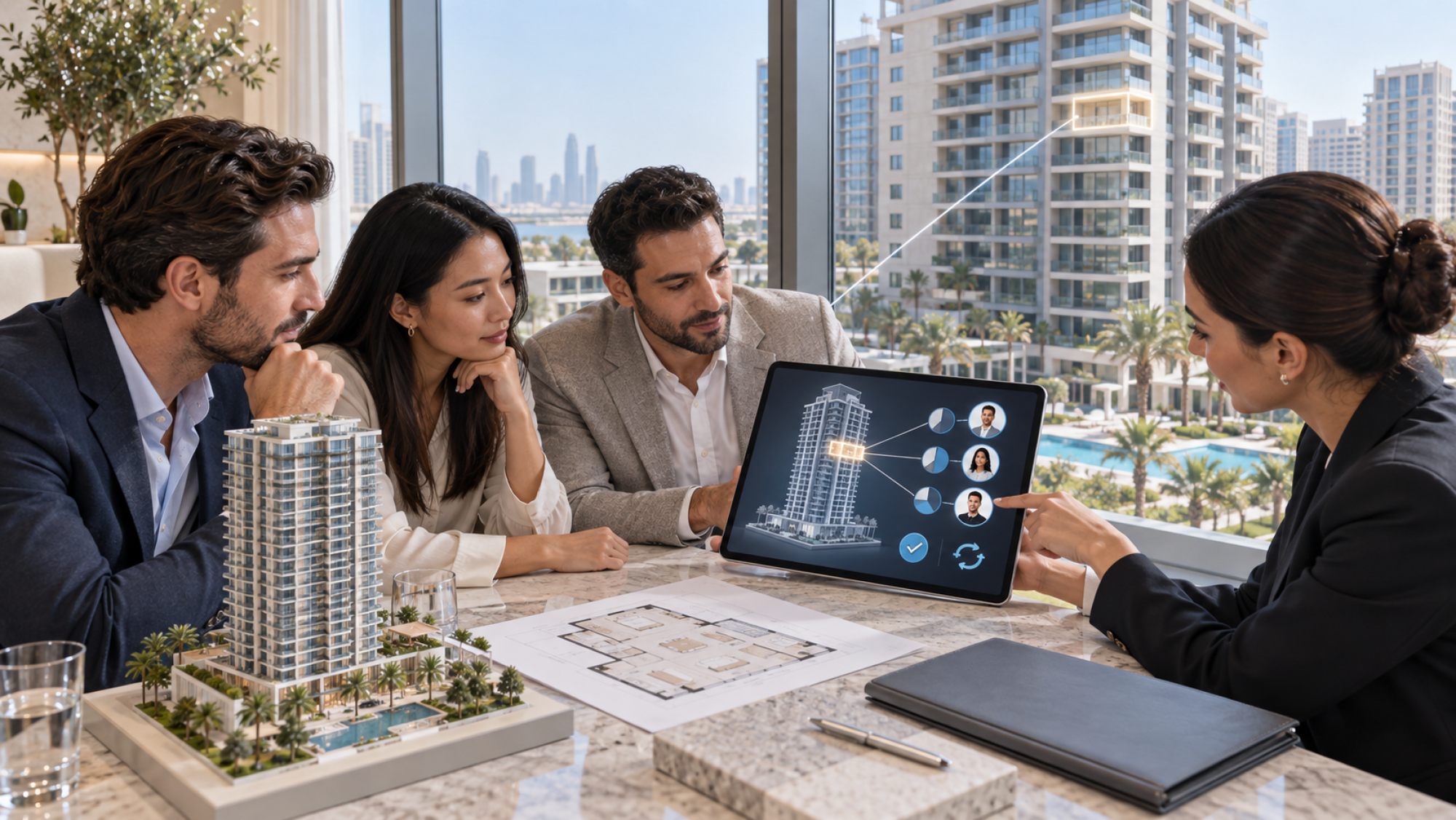
1. Choose an approved listing. Review the property, valuation, occupancy, expected income, fees, risks and exit terms.
2. Complete eligibility and KYC checks. The platform confirms identity and whether the investor can participate.
3. Select an investment amount. The contribution determines the fractional interest, subject to the listing’s minimum and limits.
4. Pay and receive the recorded interest. Use the approved payment route; the registry process connects the fraction to the ownership record.
5.
Earn or exit under the terms. Income,
decisions and resale follow the disclosed rules and available market
mechanisms.
Simple fractional ownership calculation
Illustrative ownership share = investor
amount ÷ tokenized property value × 100
Example: AED 10,000 ÷ AED 1,000,000 × 100 =
1%. This illustration excludes fees, limits and valuation changes. Always use
the listing documents because the amount offered may differ from the full
property value.
Can Dubai property tokens be resold in 2026?
Yes, secondary resale is being tested in
Phase II, but the accurate answer needs a qualification. DLD said resale
activity for approximately 7.8 million real estate tokens would begin from 20
February 2026. It also described the activity as a controlled pilot designed to
test market efficiency, operational readiness, governance and investor
protection.
VARA separately described Phase II as
controlled testing and evaluation of additional functions, including
secondary-market mechanisms. Therefore, investors should not interpret “resale
enabled” as a promise of continuous liquidity or universal access.
Liquidity: what secondary resale changes
A secondary mechanism may let an eligible
holder offer tokens to another eligible buyer without selling the whole
property. However, execution still needs a willing buyer, compliant transfer,
platform availability and an acceptable price. Demand, valuation and rental
performance remain important.
Tokenized property vs buying a full apartment in Dubai
|
Factor |
Tokenized fraction |
Full apartment |
|
Entry amount |
Smaller, listing-specific fractional ticket |
Full purchase price plus acquisition and ownership costs |
|
Ownership |
Fractional interest under the approved registry and token structure |
Direct ownership of the entire registered unit |
|
Control |
Shared and governed by disclosed rules |
Owner controls leasing and sale, subject to laws and contracts |
|
Income |
Proportionate distribution after disclosed costs |
Owner receives rent and pays all property costs |
|
Exit |
Sell eligible tokens if the controlled market has buyers |
Sell the whole property through the conventional transfer process |
|
Financing |
Product-specific; do not assume mortgage availability |
Mortgage may be available subject to lender approval |
|
Main risk |
Platform, regulatory-stage, liquidity and asset risk |
Asset, financing, vacancy, service-charge and resale risk |
Can foreigners invest in tokenized real estate in Dubai?
International participation is planned but
was not universally open in August 2026. DLD’s May 2025 launch limited the
pilot to UAE ID holders; its February 2026 update said participation and
platforms may expand subject to evaluation and approvals.
Emirates ID holders must still satisfy
platform and KYC rules. Non-residents should verify eligibility before
transferring money.
Investor checks before buying fractional property in Dubai
Compare projected income using SAMANA’s Dubai real estate ROI guide and calculate the
tokenized investment after all property and platform costs.
- Verify the platform and every relevant authorization through official DLD and VARA communications; do not accept a marketing claim as proof.
- Confirm what you legally own, how the interest is recorded, and which document proves that ownership.
- Review the valuation, tenancy, rent, service charges, maintenance, insurance and all fees; calculate net income after costs.
- Understand voting rights, sale
rules, lockups, resale eligibility, pricing controls and what happens if no
buyer appears.
What Dubai real estate tokenization means for investors
Dubai’s model could widen access and
improve transferability. DLD’s AED 60 billion projection for 2033 is a
forecast, not today’s market value. Tokenized property remains an emerging real
estate product, not cash, guaranteed income or a freely traded cryptocurrency.
Investors comparing fractional and full
ownership can review SAMANA’s first-property buying guide or explore
SAMANA projects across Dubai. SAMANA Developers does not claim
participation in the DLD tokenization initiative unless confirmed through
official channels.
Frequently asked questions
Is a Dubai property token a title deed?
No. The token is a digital unit
representing a defined property interest. The authoritative ownership position
depends on the DLD registry and approved legal structure. Ask how the fraction
is recorded and which official document proves it.
Can property tokens be resold in Dubai?
Yes, resale mechanisms entered controlled
Phase II testing from 20 February 2026 for about 7.8 million tokens. Resale is
not guaranteed: a transaction still depends on eligibility, platform rules,
approvals, market demand and an available buyer.
Can foreigners buy tokenized property in Dubai?
Not every foreign investor can currently
assume access. The initial official pilot was limited to UAE ID holders.
International expansion is planned, but non-residents should verify the latest
DLD, VARA and platform eligibility before investing.
What is the minimum investment for tokenized property in Dubai?
There is no single permanent minimum for
every offering. The amount depends on the authorized platform, property and
current listing terms. Verify the live minimum, fees and ownership share before
paying.
Can I buy Dubai property tokens with cryptocurrency?
DLD stated that initial pilot transactions
were completed only in UAE dirhams, with no cryptocurrency used. Do not assume
a crypto payment route is permitted unless an authorized platform and current
official rules clearly confirm it.
Do Dubai property tokens qualify for a Golden Visa?
Do not assume they do. Property-based
Golden Visa eligibility depends on current immigration and DLD evidence
requirements, including qualifying real estate value and accepted ownership
documents. A fractional token balance should not be presented as automatically
eligible; obtain confirmation for the exact structure before investing for
residency purposes.
Do tokenized properties pay rental income?
They may distribute a proportionate share
of eligible net rental income, depending on the property and offering terms.
Review vacancy, service charges, maintenance, management fees, reserves and
distribution timing before estimating returns.
Is tokenized real estate safer than buying a full apartment?
It has a lower entry amount and may improve
diversification, but it adds platform, regulatory-stage and secondary-liquidity
risks. A full apartment requires more capital but generally gives the owner
more direct control. Neither route guarantees return.